

1 in 8 Billion
Korean indie developer Jin Hwi-eus made a free life simulation for your browser: be born at random as one of today's babies and live that one life to its end, on the real statistics of 172 countries.










About 1 in 8 Billion
1 in 8 Billion (80억 분의 1 in Korean, 1in8b for short) is a free life simulation that runs in the browser. About four babies are born on Earth every second, and you become one of them. Where you are born, and to whom, is drawn the way real births fall, so about a third of all lives begin in India, China, Nigeria or Pakistan. Then the life runs year by year on that country's statistics until it ends.
There is no score and no way to win. You choose what each year is for and decide when school, work, love, a move abroad or a hospital comes up, but choices only shift the odds. Most lives turn out ordinary, some end in infancy, and none can be replayed. It is made for ages 15 and up: illness, war, poverty, violence and suicide happen as often as the statistics say, never shown, and always with where to find help.
Two weeks after its October 5, 2026 launch it had 172 countries, ten language editions and 348 update notes, and Dragon Quest creator Yuji Horii and entrepreneur Takafumi Horie had posted the lives they lived.
Gameplay
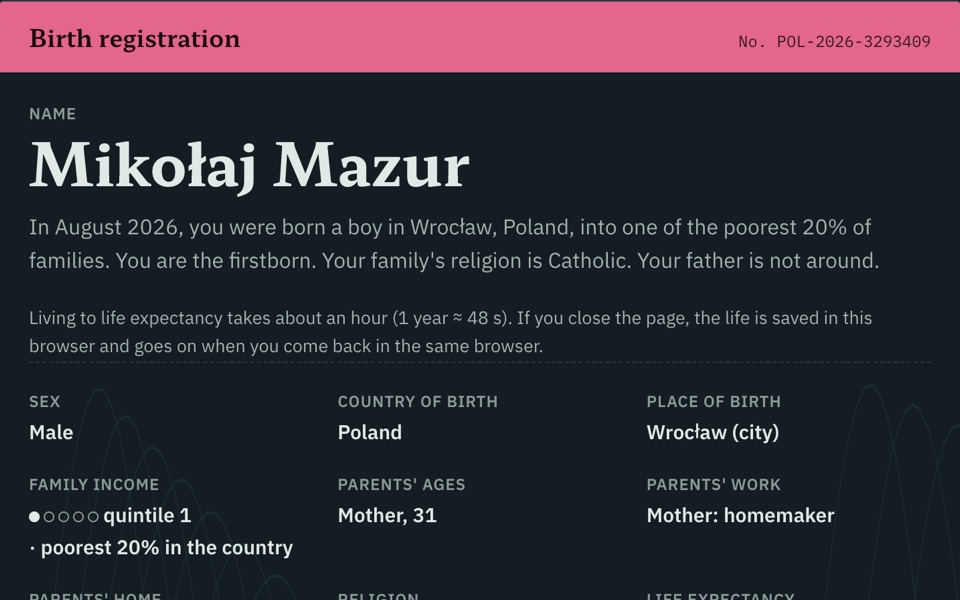
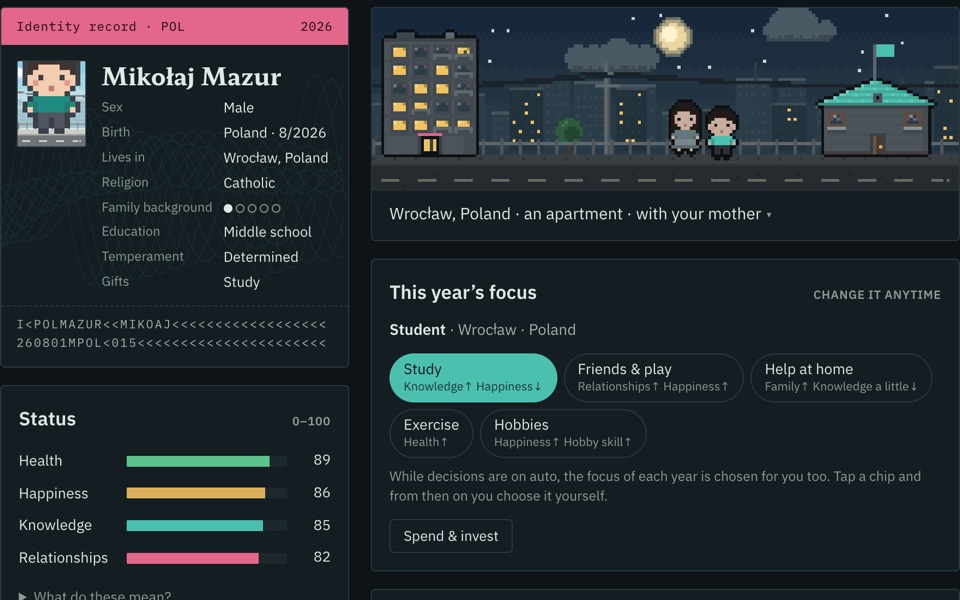
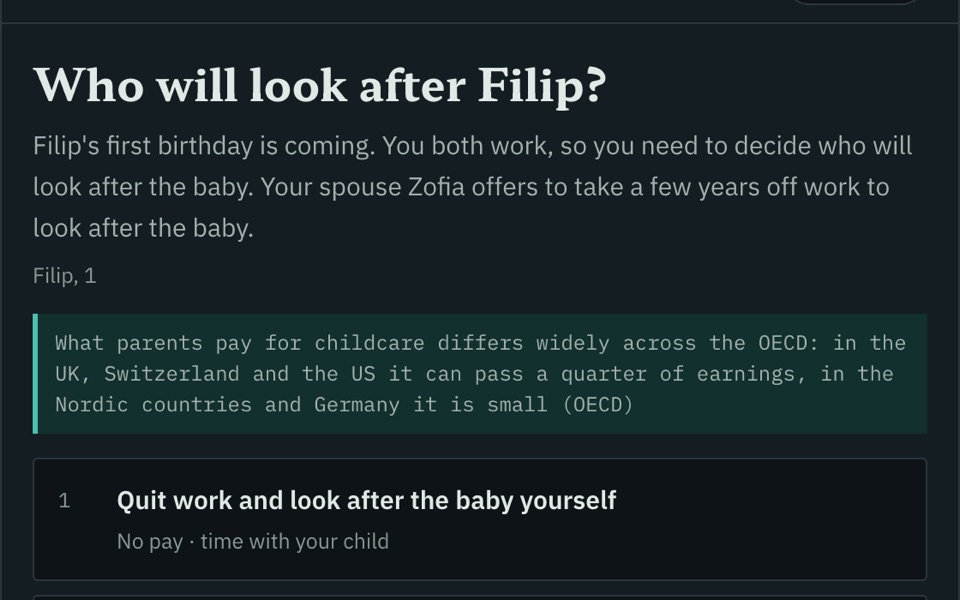
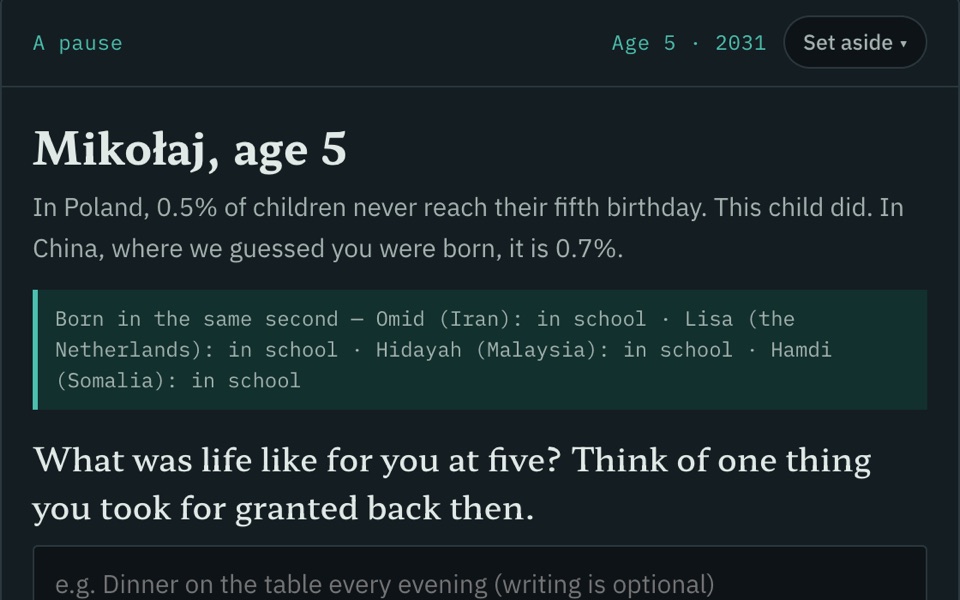
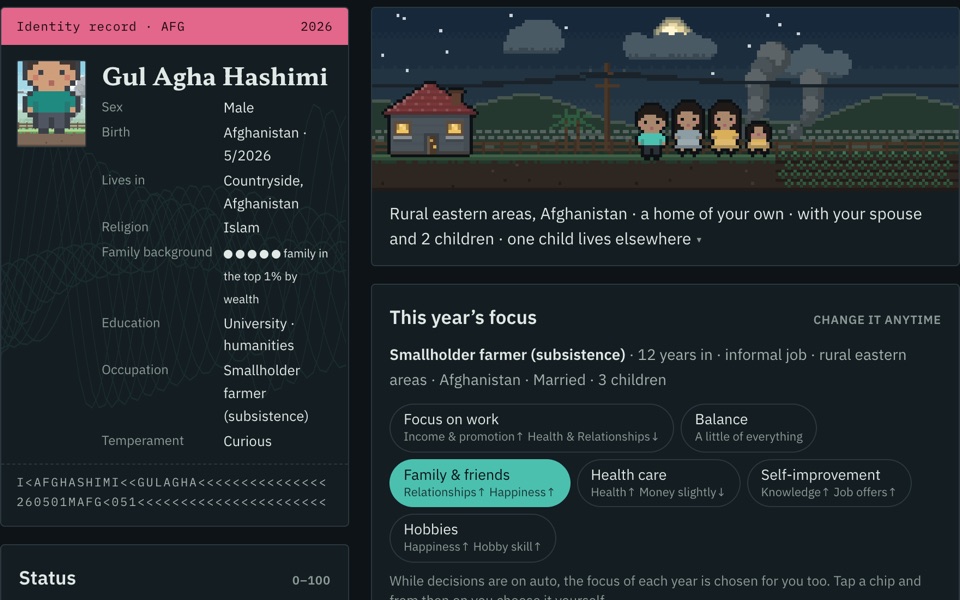
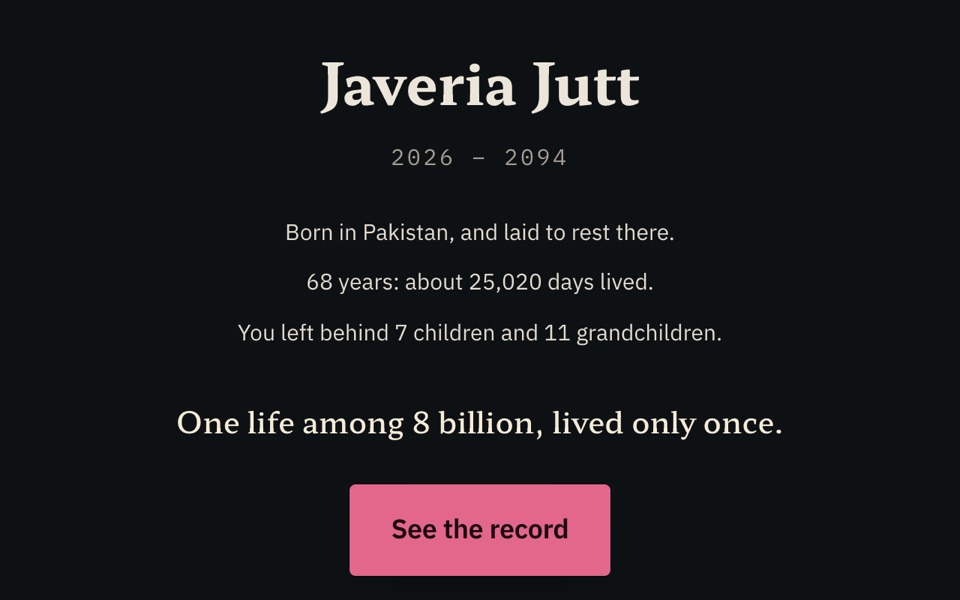
How a life plays
- Be born
Pick the world (today, any year from 1950 to 2025, the future, or any) and how the country is drawn: by births, the default, or by population. Then come the country, city or village, sex, family and its means. No payment changes the draw.
- Live year by year
At the default length a year passes in 40 to 60 seconds. Pause any time, speed up to 16×, or turn on auto mode and just watch. Close the page and the life waits in that browser.
- Choose and decide
Each year you lean toward study, work, family or health. School, a job, marriage, a home, emigrating or treatment come as decision cards that quote the real figure behind them.
- Four strangers
Four other babies born in the same second, somewhere else, live by the same statistics beside you, so you watch how far apart lives drift.
- Five pauses
At 5, 15, 30, 50 and 70 time stops and asks one question about this life and yours. You can leave a line, and at the end a few words to the person.
- The end
The age at death comes from the country's life tables by sex, the cause from WHO and Global Burden of Disease patterns. A death record, a life map (one square per year) and a share card follow, all free.
Your odds of being born
This is the draw the game makes at birth, from UN World Population Prospects 2024 (about 132 million babies born in 2023). Life expectancy and child deaths differ just as much: 84.7 years and 0.2% before age five in Japan, 54.5 years and 11.7% in Nigeria.
Who made it, and how it started
1 in 8 Billion is a one-person project made with AI. Its developer goes by the pseudonym Jin Hwi-eus (진휘어스), runs the game as Jin's Earth and keeps their real identity private. The fullest account is a written interview with Korea's Kukmin Ilbo, done on October 9, 2026 and published the next day (article ↗).
- The idea
Struck by how differently people live outside their own circle, the developer had long wanted to turn being one random person among Earth's 8 billion into a game.
- October 5: the prompt
The request to Claude: a simulation of being born at random as one of the 8 billion people on Earth and living that person's whole life, based on real-world statistics as far as possible.
- About 4 hours: a public linkThe four hours are the time from the first prompt to a public test link, not the time behind today's game: the statistical model, the mechanics, the languages and the fixes have kept growing since, through 348 update notes. In the same interview the developer said about 58% of started lives had been played to the end, without disclosing total visitors. That figure and the traffic jump come from the developer, not from audited data.
Two hours in, the first life came out (born in Nigeria, died of malaria at five). That evening the developer shared the making-of on Threads and asked for testers; commenters asked for a link, so the site went up and the domain was bought on the spot.
- Then: it spread
The developer posted only on Threads, but the link spread to online communities, X and KakaoTalk. On October 7, daily visits were nearly seven times the day before.
How it was made
- Model
- Claude Opus 5.5, at the Extra effort levelPrompt on Threads, Oct 5 · Shueisha Online interview, Oct 16
- Tool
- Claude chat. How code gets from the chat to the site isn't disclosed."I only use Claude chat to do everything", X, Oct 16
- Who does what
- The site says the words and code are written with AI, and the operator decides what goes in and checks it. The developer calls the AI a colleague that designed the code.About page · Shueisha Online, Oct 16
- First version
- About 4 hours from the first prompt to a public link, the developer saysKukmin Ilbo interview, Oct 10
- Art and music
- Pixel scenes, portraits and memorial rooms are drawn on canvas by the game's own script, with no image files. The calm background music is synthesized in the browser.Seen in the game's code, Oct 22 · update note v0.4.4, Oct 5
- Data
- UN World Population Prospects 2024, UN IGME, WHO, UN MMEIG, UNDP, UNESCO, the World Bank, ILO, UN-Habitat, UNAIDS, UNODC, UNICEF and the World Happiness Report. Income follows each country's Gini distribution; gaps are filled from regional averages. The statistics weren't prepared in advance: developer and AI looked them up and added them as the game grew.About page
- Stack
- Plain JavaScript, one script per language with no framework, on Cloudflare; code in a private GitHub repository; Stripe for paymentsPrivacy policy and terms; the game's code
- Updates
- 348 update notes from v0.1 on Oct 5 to v0.7.98 beta on Oct 21, up to 44 in a day. Feedback and support email are read and sorted with Claude; the developer checks and sends every reply.The game's update notes
- Cost
- Not disclosed
- Money
- Free, with no ads and no sign-up. The only paid item is an optional keepsake pass ($3) that turns a finished life into a film, an album and a memorial. Ko-fi tips closed on Oct 8; the developer turns down company offers.Update notes v0.4.87 and v0.5.33 · Shueisha Online
What people said
The game went furthest in Japan, where it took off on October 13 after AUTOMATON's report and a player's post about crying a little when their character died. Within days these well-known people had played it. Their words, translated from Japanese by us:
Lived quite a long life.
けっこう長生きでした。
Posted with the life: a boy from rural Tajikistan who died at 92.
Amazing site.
すごいサイト。
Posted with the life: a girl from rural India who farmed for 53 years and died at 73.
So games like this can now come out of AI. It was an amazing experience. Games may start to take on part of what literature has carried until now.
こういうゲームがAIで生まれてくるのか。すごい体験だった。これから今まで文学が担っていた一部を、ゲームが担うようになるのかもしれない。
I'd been planning something similar but different, but 1 in 8 Billion is better made. Gutted.
似て非なるものを企画してたけど、「80億分の1」のほうがよくできてる。くやしい。
Whether it's even a game is another matter. There's no winning strategy, and no winning or losing.
ゲームなのかどうかは別なのよ。必勝法もなければ勝ち負けもなくて
On the TBS Radio late-night show JUNK 伊集院光 深夜の馬鹿力, as transcribed by Sirabee.
I was born into a middle-class family in Brazil. Seen this way, being born in Japan could be called pure chance, or a miracle.
ブラジルの中流家庭に生まれました。こう考えると、日本に生まれることもたまたまとも言えるし、逆に奇跡と言えるかもしれません。
This game is also a pretty excellent asset-building simulator.
このゲームがかなり優れた資産形成シミュレーターでもある
Written after playing a life in Tanzania, about riding out recessions with stocks and bonds.
There may be similar lives, but no two are the same.
似た人生はあっても、同じ人生はどこにもない。
Timeline
- The prompt goes to Claude (shared on Threads, labelled "Opus 5.5 Extra"). About four hours later the game is public, in Korean, with 141 countries; 16 updates ship that day, including the move to 1in8b.life. Post ↗
- English edition (v0.4.41). The developer's 24-hour recap: 42 updates so far. Post ↗
- Keepsake pass and memorials (v0.4.87).
- Past (1950 to 2025) and future worlds (v0.5.20). Ko-fi tips close (v0.5.33).
- Japanese edition (v0.5.81). The developer answers Kukmin Ilbo's questions in writing; the interview runs the next day. Article ↗
- Suicide is added as a cause of death (v0.6.36), at real rates from the teenage years on, never shown and never a choice. It had been left out at launch; on Oct 14 the developer explained on X that leaving it out had erased those lives. Reply ↗
- It takes off in Japan: AUTOMATON reports it and Takafumi Horie posts a life.
- 172 countries instead of 141 (v0.6.95) and a Traditional Chinese edition (v0.7.2). Business Insider Japan reads it as an asset-building simulator.
- Vietnamese edition; the first screen now says the game is made with AI (Claude) (v0.7.10). Taiwan's press picks it up, and the developer says users in Taiwan and Hong Kong now outnumber Korean ones. Answering players who called parts of it biased, the developer agrees personal biases can shape the data and asks for feedback.
- Yuji Horii posts a life. Shueisha Online runs the longest interview yet, and the developer posts: "I only use Claude chat to do everything." Post ↗
- French and Thai editions.
- Simplified Chinese, Spanish and German editions.
- v0.7.98 beta. The keepsake pass is no longer sold in South Korea (v0.7.96).
- Still online, free and playable without sign-up (our check).
Press coverage
- Kukmin IlboKorea · Oct 10, 2026“한국에서 태어난 건 축복이다” 입소문 탄 ‘80억 분의 1’ 뭐길래 ↗Written interview with the developer: the prompt, the four hours, the suicide decision
- AUTOMATONJapan · Oct 13, 2026“統計に基づくリアル人生”シミュレーター『80億分の1』大流行中。生まれはガチャで生き方は自分次第、生々しい人生見守りブーム ↗The report that started the buzz in Japan
- DenfaminicogamerJapan · Oct 14, 2026生まれる場所を“選べない”人生シミュレーションゲーム『80億分の1』が話題。「死んだ時に泣いてしまった」「幸せってなんだろう」などの声が寄せられる ↗What players said
- Business Insider JapanJapan · Oct 14, 2026「80億分の1」をプレイして、“資産形成”の意味を知ったかもしれない ↗Played as a lesson in investing
- AUTOMATONJapan · Oct 14, 2026大流行中“人生ガチャ”シミュレーター『80億分の1』、実はアプデで「自殺エンド」が入っていた。開発者は当初は葛藤し見送り、でも“生き方を除外しないため”実装 ↗Why suicide was added
- Business Next (數位時代)Taiwan · Oct 15, 202680億分之1遊戲是什麼?AI開發4小時完成,玩法與免費體驗網址一次看 ↗What it is, how to play, where to play
- NOWnewsTaiwan · Oct 15, 2026《80億分之1》人生模擬遊戲台日韓爆紅!韓國開發者親揭理念 ↗The developer's idea, from the Kukmin interview
- THISTOKYOJapan (English) · Oct 15, 2026"1 in 8 Billion" Is Trending: A Life Simulation Game Where You Can't Choose the Country You're Born In ↗
- Shueisha OnlineJapan · Oct 16, 2026「死んだときに泣いた…」国も親も選べず、やり直しもできない“理不尽な人生ガチャ“ゲーム”が世界で大反響 『80億分の1』開発者を直撃 ↗The longest interview: Opus 5.5, four hours, AI as a colleague
- EdailyKorea · Oct 17, 2026태어나는 순간부터 갈리는 삶…스레드 달군 ‘80억분의1’ ↗A reporter's review after more than ten lives
FAQ
Is 1 in 8 Billion free?
Yes. Every life and its ending are free, with no sign-up and no ads. The only paid item is an optional keepsake pass ($3) that makes a film, an album and a memorial from a finished life. It isn't sold in South Korea.
Who made it?
Jin Hwi-eus (진휘어스 in Korean), the pseudonym of a Korean indie developer who runs the game as Jin's Earth and keeps their real identity private. It is a one-person project made with AI; the developer posts on X and Threads as @jins__earth.
What AI was used to make it?
Claude Opus 5.5, at the Extra effort level, in Claude chat, according to the developer. The site says the words and code are written with AI, and the operator decides what goes in and checks it.
How long did it take to make?
About four hours from the first prompt to a public test link on October 5, 2026, the developer says. That is the first version only: the game has been updated almost hourly since, with 348 update notes in 17 days.
Is it based on real data?
As far as public statistics allow: births and life expectancy from UN World Population Prospects 2024, child deaths from UN IGME, causes of death from WHO and the Global Burden of Disease study, income from the World Bank, and more. The developer names the limits: most numbers are national averages, and the poorest places have the least data.
Can I choose where I'm born?
No. The country is drawn by births, or by population if you choose that, and no payment changes it. You can optionally enter where you were really born to compare the two lives.
How long does one life take?
About 30 minutes, 1 hour (the default) or 1.5 hours to reach the country's life expectancy. You can pause, speed up to 16×, or close the page and continue later in the same browser.
Related games
Yuji Horii, who posted a life above, also made a game with Claude: Komiya in the Interrogation Room. More games made with Claude Opus 5.5:
Komiya in the Interrogation Room
Question an elderly ex-locksmith, break his lies with evidence and get a confession before his lawyer arrives.
@YujiHoriiPlayThe Little Prince: Among the Stars
Travel planet to planet through the Little Prince's story, each world a small 3D scene to explore.
@Saccc_cPlayCheck papers at a pixel-art border booth and catch travellers pretending to be American, over six days.
ctnyanyaPlay


